
–>
Standing wheelchairs have become one of the most requested categories in rehabilitation equipment procurement. Clinics want them for gait training programs, nursing homes want them for pressure care, and families want them for daily independence. But with child models, adult models, sit-to-stand mechanisms and folding power alternatives on the market, choosing the right one is not obvious.
This guide walks through the decisions that actually matter: who benefits from a standing wheelchair, what to check before buying, how child and adult models differ, and when a folding power wheelchair is the smarter choice. It closes with our own QDL lineup so you can see how the theory maps to real products.
Why Supported Standing Matters
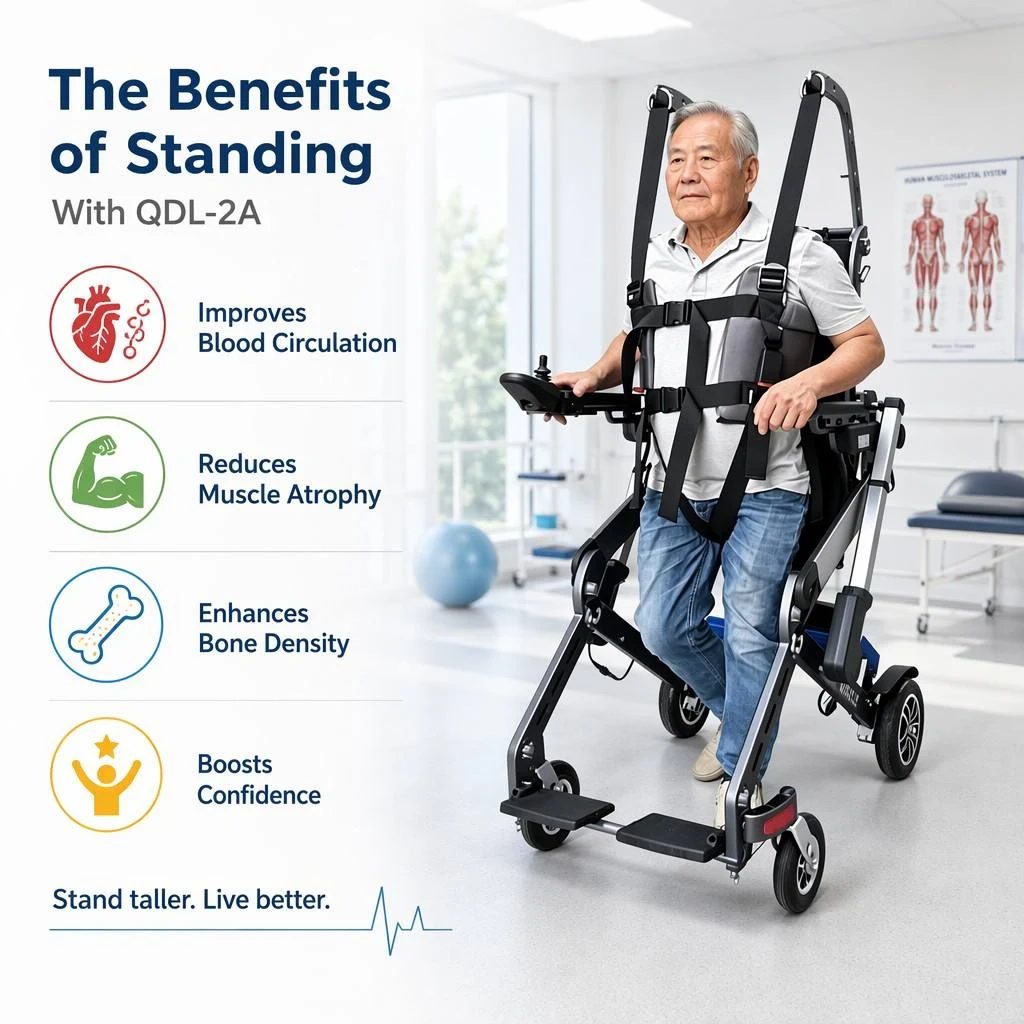
For many users with limited mobility, remaining seated all day is the default — and the problem. A standing wheelchair supports the user in a upright, weight-bearing position safely and repeatably. Commonly cited benefits of a regular supported standing routine include:
- Better circulation and reduced risk of pressure issues from prolonged sitting
- Weight-bearing through the legs and hips, which care teams often target for bone and joint health
- More natural eye-level interaction at home, in school and in clinics — which matters enormously for children
- Stretching of hip, knee and ankle flexors as part of a therapy program
Who Is a Good Candidate?
Standing wheelchairs are typically considered for users who cannot stand safely on their own but have enough skeletal and skin integrity to tolerate a supported standing position. Typical groups include children with cerebral palsy, stroke survivors in rehabilitation, and adults with muscular or neurological conditions.
Important: candidacy should be confirmed by a therapist or physician, especially for children, users with osteoporosis, contractures, or orthostatic hypotension. A responsible supplier will ask about the user’s condition before recommending a model — if a vendor tries to sell you a standing frame without asking, treat that as a warning sign.
For users who can benefit from robotic gait training rather than passive standing, a rehabilitation exoskeleton may be the better tool — see our exoskeleton buyer’s guide for that path.
Standing Wheelchair or Folding Power Wheelchair: Which Do You Need?
This is the question buyers get wrong most often. The two categories look similar in photos but solve different problems:
- A standing wheelchair is a therapy and posture device. You are buying the lift: a powered sit-to-stand mechanism that makes standing a repeatable part of the user’s day.
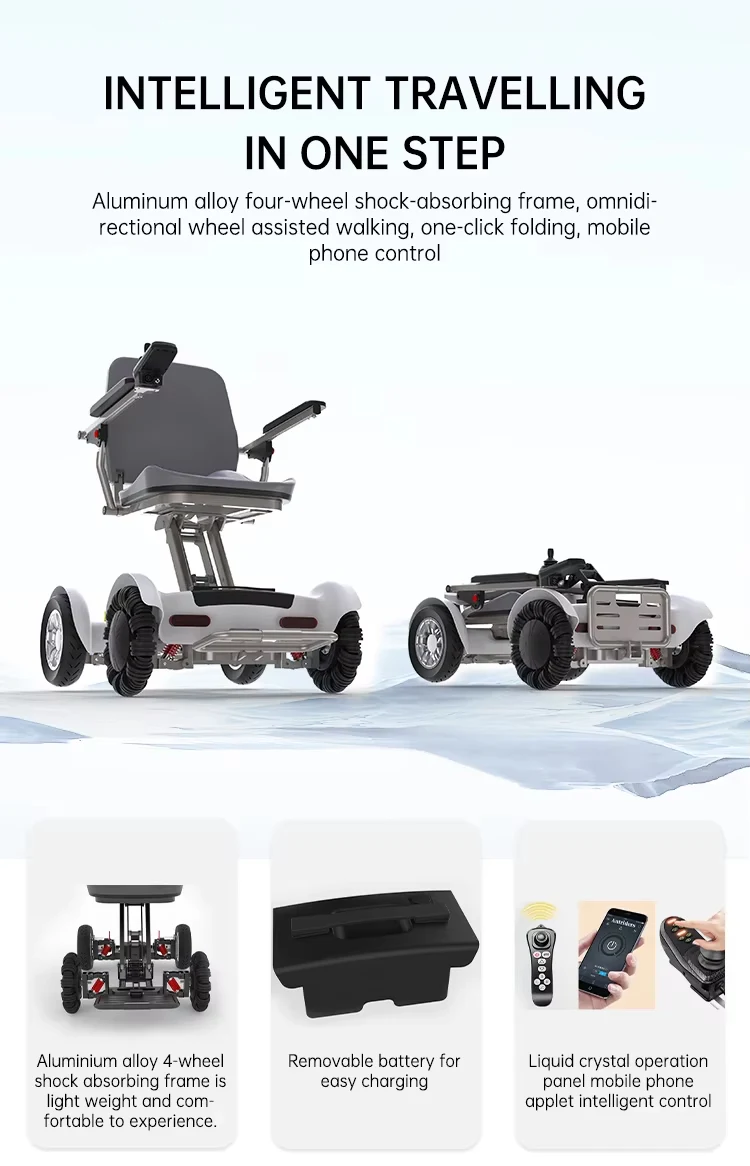
- A folding power wheelchair is a mobility device. You are buying range, portability and convenience — with no standing function at all.
If the user’s care plan includes standing goals, choose a standing model. If the priority is daily transport with minimal effort — for example an elderly user who mainly needs to move around comfortably — a folding power wheelchair such as our Climber-A1 Pro (25 kg, APP-controlled, automatic folding, up to 30 km range) is often the better and more economical answer. Buying standing function you will not use is wasted budget; buying a folding chair for a user who needs standing therapy is a missed opportunity.
Six Factors to Check Before You Buy
1. User height and weight fit
Check the user height range and maximum load capacity against the actual user — not an average. Pediatric users need a chair that grows with them; bariatric users need headroom on the load rating.
2. The sit-to-stand mechanism
Look at the actuator thrust (this determines how smoothly and safely the lift runs under load), whether the standing angle is adjustable, and whether the user can stop at intermediate positions. A 1000 N class actuator is the mainstream choice for powered standing wheelchairs.
3. Everyday usability
Battery capacity and travel range determine whether the chair lasts a full school day or therapy session. Solid (non-pneumatic) tires eliminate flats — a real advantage in clinical environments. Adjustable speed limits matter for indoor safety.
4. Caregiver workflow
Who operates the lift and how? Look for dual controls (user + attendant), brake design, and whether transfers in and out of the chair are practical for your staffing.
5. Documentation for your market
If you are a distributor, ask early: which certificates and technical documents are available for this model, and what support exists for local registration? Certification status varies by model and destination market, so request the document package with your quotation.
6. After-sales and parts
Actuators, batteries and controllers are the three components that matter over a service life. Confirm warranty terms, spare parts availability and remote technical support before signing.
Child vs Adult Models: What Actually Changes?
The core sit-to-stand technology is the same. What changes is the envelope and the framing of the therapy goals:
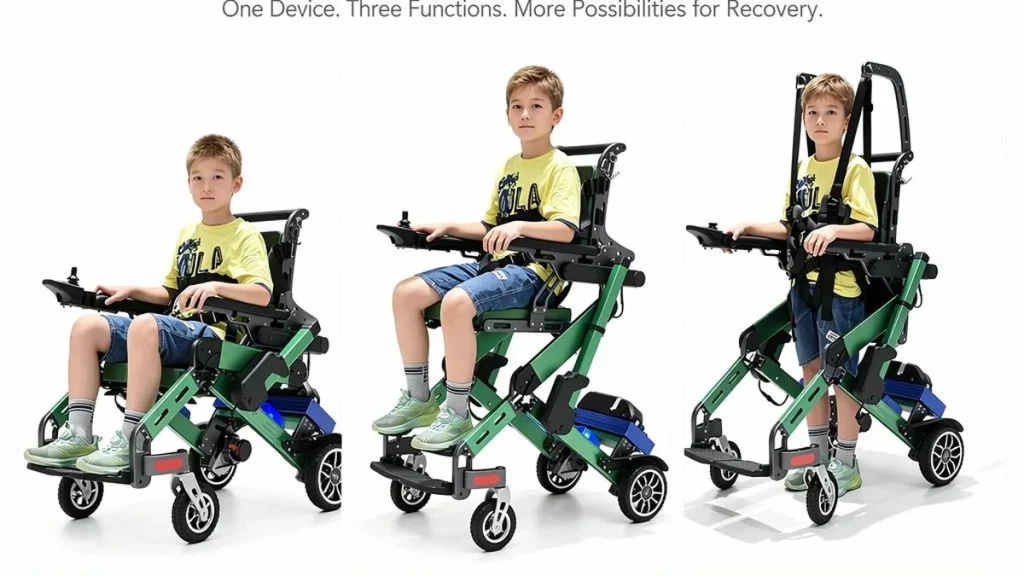
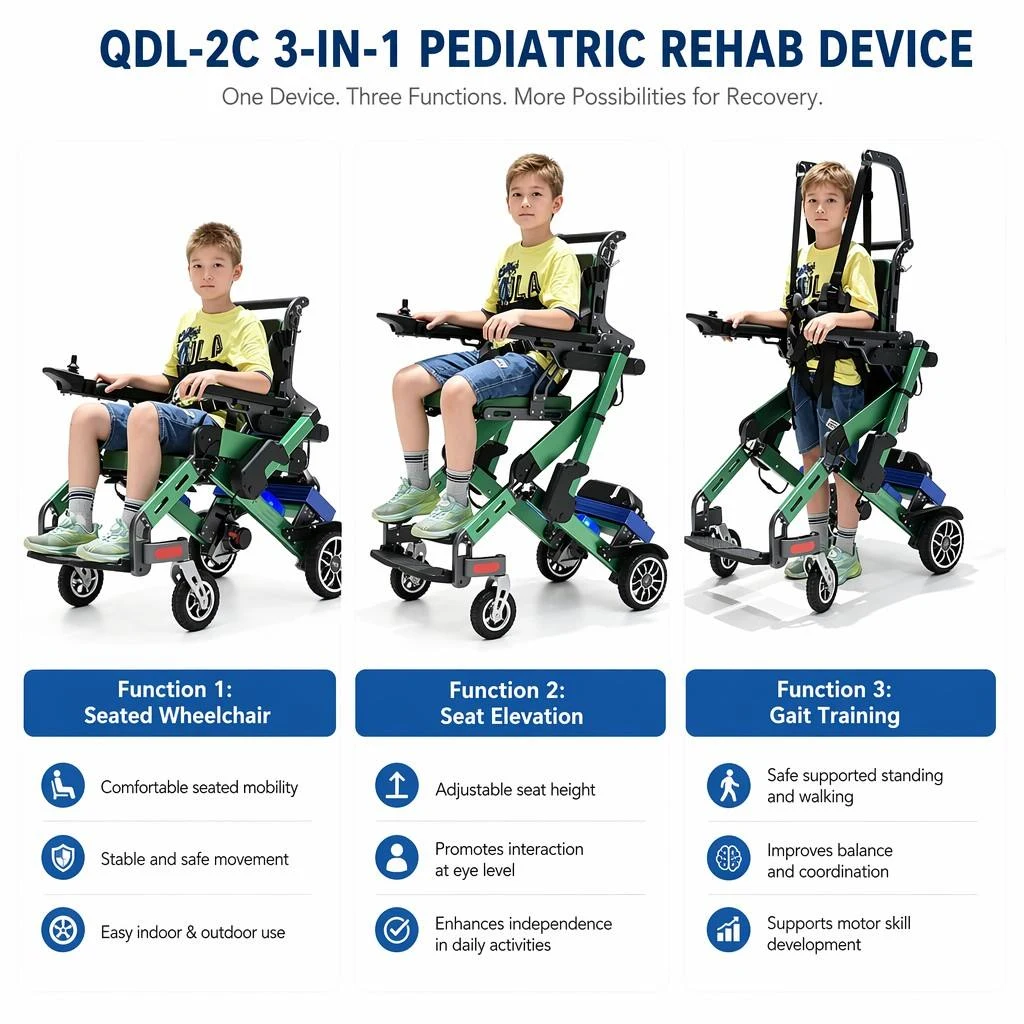
- Child models cover much smaller user heights, use lighter load ratings, and are positioned around developmental goals — school participation, therapy for cerebral palsy, and sit-to-stand training as part of pediatric rehabilitation.
- Adult models extend to full adult height and weight, add quick-charge battery options for all-day clinical use, and are typically procured by rehab centers for stroke and neurological rehabilitation programs.
Our Standing Wheelchair Lineup
We manufacture two powered standing wheelchair models covering children through large adults, plus a folding power wheelchair for users who do not need standing function:
| QDL-2C-H (Child, 3-in-1) | QDL-2A-H (Adult, Clinical) | |
|---|---|---|
| Best for | Children and small users; cerebral palsy and stroke recovery | Adults; clinical gait training in rehab centers |
| User height | 20 – 160 cm | 150 – 190 cm |
| Max load | 50 kg | 100 kg (220 lbs) |
| Battery | 24V 15Ah lithium-ion | 24V 15Ah lithium-ion (quick-charge) |
| Max speed | 6 km/h | 6 km/h (adjustable) |
| Lift actuator | 1000 N | 1000 N, dual independent control |
| Standout detail | 3-in-1: power wheelchair + sit-to-stand aid + gait trainer; solid non-pneumatic tires | Reinforced aluminum alloy frame for daily clinical use |
Explore the models here:
- QDL-2C-H — 3-in-1 Child Electric Wheelchair with Standing Function — pediatric gait trainer for cerebral palsy and stroke recovery
- QDL-2A-H — Professional Adult Powered Standing Wheelchair — clinical gait training system for rehab centers
- Climber-A1 Pro — Foldable Electric Wheelchair — the folding alternative when standing function is not required
For Distributors: OEM, Low MOQ and Documentation
We are the manufacturer behind these models (Guangxi Dynasty Medical Device Technology Co., Ltd.). For distributors and clinic groups we support:
- MOQ of 1 piece — evaluate a single unit with real users before committing to volume
- OEM/ODM customization — logo, color, manual and packaging branding, with sampling in about 7 days
- Standard delivery of 10–15 days after order confirmation
- Documentation support — certificate copies and technical documents for your local registration
More on our OEM and ODM program.
Frequently Asked Questions
What is a standing wheelchair and who is it for?
A standing wheelchair supports the user from sitting to a safe, upright standing position using a powered lift. It is designed for users who cannot stand unassisted — such as children with cerebral palsy or stroke survivors — so that supported standing becomes a repeatable part of daily care.
What are the benefits of supported standing?
Care teams commonly use supported standing to work on circulation, pressure management, weight-bearing through the legs, and eye-level participation in daily activities. Goals should be set with a therapist for each user.
What is the difference between the child and adult models?
The lift technology is the same; the envelope changes. The child model (QDL-2C-H) fits user heights of 20–160 cm with a 50 kg load rating and adds a 3-in-1 wheelchair / sit-to-stand / gait-trainer design. The adult model (QDL-2A-H) fits 150–190 cm, carries up to 100 kg, and adds a quick-charge battery for all-day clinical use.
Do I need standing function, or is a folding power wheelchair enough?
If standing therapy is part of the care plan, buy a standing model. If the user mainly needs comfortable daily transport, a folding power wheelchair like the Climber-A1 Pro (25 kg, auto-folding, 30 km range) is the more economical choice.
What is the MOQ, and can we add our own brand?
The MOQ is 1 piece. OEM and ODM customization — logo, color, manual and packaging — is supported, with sampling in about 7 days and standard delivery of 10 to 15 days.
What about warranty and certification?
Warranty terms are confirmed in the order contract. Certification status varies by model and destination market; we provide certificate copies and technical documents with every order to support local registration.
Talk to the Manufacturer
Tell us the user’s age, condition and care setting — or your target market and volume if you are a distributor — and we will recommend the right model and configuration. Send us an inquiry; we reply with a proposal, not a price list, because the right configuration comes first.